Adhering to the philosophy of symbiosis and committed to reform and innovation, AICA Group regards sustainable development as a corporate policy on par with business strategy. These shared values guide all employees in addressing social challenges through business activities to build a better society.
Based on ISO 14001 and its proprietary QEO management system, the Group actively tackles environmental issues by:
Supplying safe, reliable products with a smaller environmental footprint;
Reducing greenhouse gas emissions through energy conservation and renewable energy;
Promoting the 3Rs (Reduce, Reuse, Recycle) to foster a circular economy while optimizing the use of natural capital such as water and timber;
Maintaining harmonious community relations and engaging in local environmental protection and social contribution activities.

Carbon footprint refers to the total direct and indirect greenhouse gas emissions generated throughout a product’s full lifecycle: raw material extraction, manufacturing, transportation & packaging, usage, and final disposal.
As the first enterprise in China’s industry to obtain carbon footprint certification, AICA adheres to a healthy, green and high-quality development path. By calculating and labeling product carbon footprints, we help consumers understand products’ climate impact, enabling them to select low-carbon solutions and contribute to carbon neutrality. We actively support the national Dual Carbon Goals of carbon peaking and carbon neutrality.

Carbon sequestration is the process of converting atmospheric carbon dioxide into organic or inorganic carbon to reduce atmospheric carbon levels. Forests absorb CO₂ through photosynthesis and store carbon in vegetation and soil. As trees mature, their net carbon sequestration rate declines. Rational utilization of mature timber and forest regeneration help maintain and boost overall forest carbon sink capacity.
AICA products use kraft paper and lignin fiber sourced from mature timber, supporting efficient utilization of wood resources.
FSC/PEFC labels appear on millions of products worldwide, ranging from tissue paper and books to milk cartons and food packaging. Simply put, choosing FSC/PEFC-certified products means supporting global forest conservation.
All AICA products carry FSC/PEFC certification. We guarantee all raw materials are sourced from independently audited forests managed sustainably under strict social and environmental standards.
Biomass raw materials refer to all organisms, their metabolites and waste generated through photosynthesis. They absorb CO₂ during growth, making them renewable, carbon-containing clean resources recognized as carbon-neutral.
AICA actively promotes plant-based biomass raw materials, with a focus on raising biomass content in our flagship melamine decorative panels. Our long-term target is to achieve 100% biomass composition.
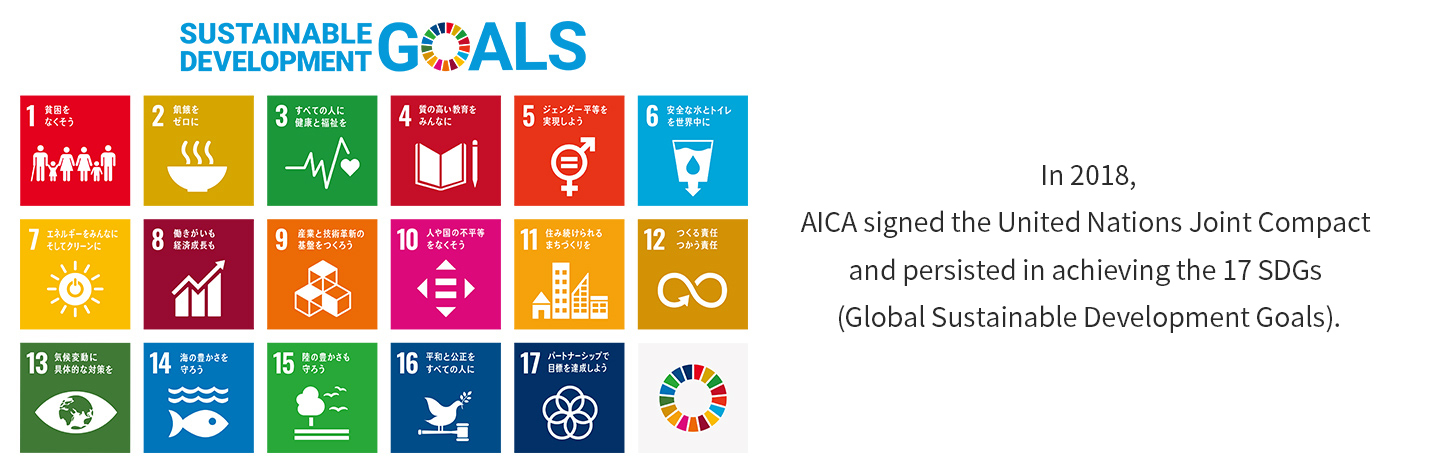
The core of AICA’s management philosophy is "Symbiosis". To embody this principle, we have long dedicated ourselves to addressing social challenges. We recognize alignment between this mindset and the four voluntary action pillars of the UN Global Compact: Human Rights, Labor, Environment and Anti-Corruption, and formally endorsed the Compact in 2018. We also commit to actively advancing the UN Sustainable Development Goals (SDGs) and have launched corresponding initiatives to meet these targets.

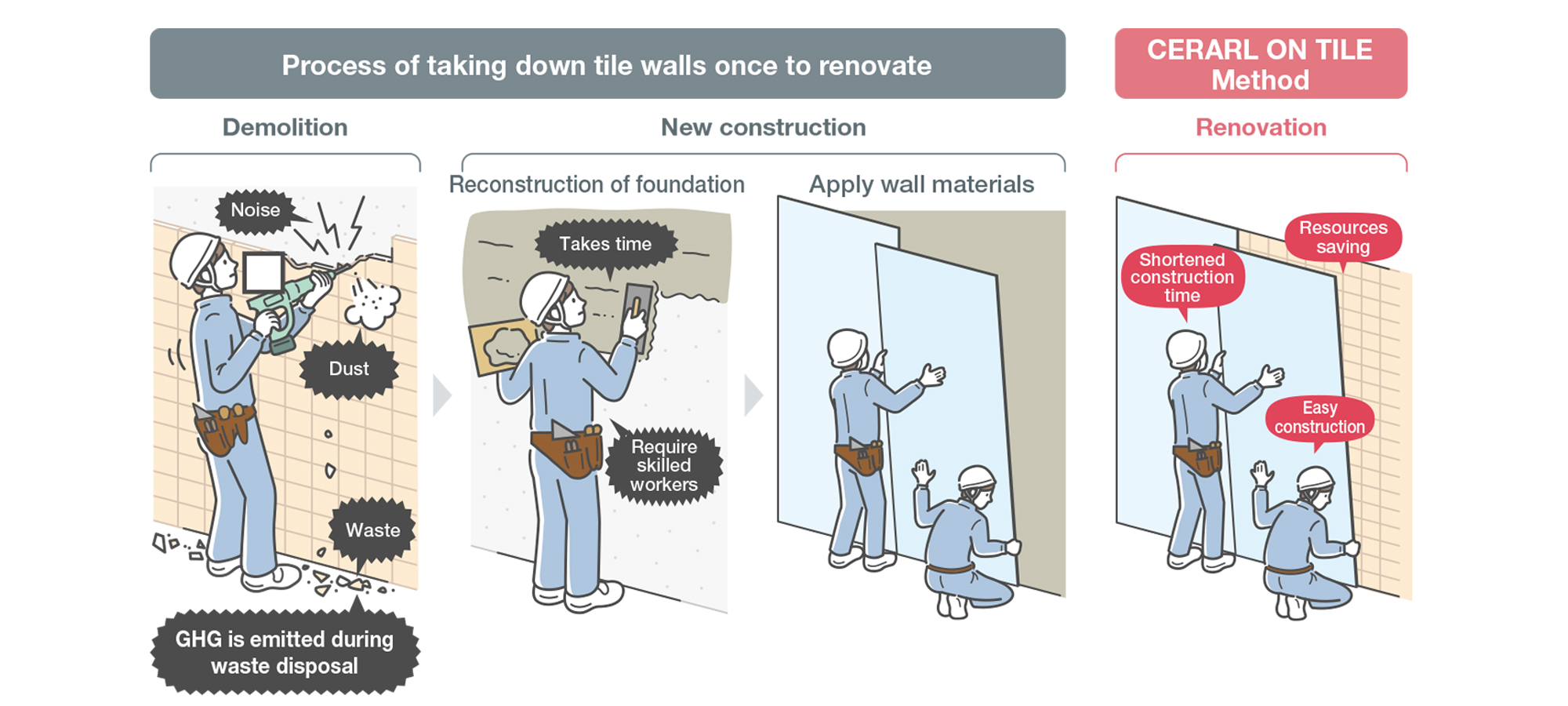
Traditional wall tile renovation requires full tile removal. AICA developed CERARL melamine fire-resistant decorative panels and dedicated SE-1 adhesive to create an innovative overlay construction method that installs new panels directly over existing tiles. This technology reduces industrial waste, noise pollution, construction duration and overall costs, lowering burdens for clients and the environment.